Enterprise hiring is fundamentally different from recruiting for a small or growing business. Large organizations may recruit across multiple departments, locations, job families, and business units while managing thousands of candidates at different stages of the hiring funnel.
At this scale, traditional interview processes can quickly become difficult to manage. Recruiters spend significant time conducting repetitive screening interviews, scheduling candidates, reviewing responses, and coordinating feedback with hiring managers.
AI interview software is helping enterprises address these challenges by automating parts of the interview and assessment process while creating a more structured and scalable hiring experience.
But enterprise adoption requires more than simply adding an AI interview tool to the recruitment stack. Organizations need a solution that can integrate with existing systems, support high candidate volumes, provide meaningful assessment insights, maintain appropriate human oversight, and meet enterprise security and compliance requirements.
What Is AI Interview Software?
AI interview software uses artificial intelligence to support or automate candidate interviews and assessments.
Depending on the platform, candidates may complete asynchronous video interviews, conversational AI interviews, audio interviews, or structured assessments. The software can then analyze responses against predefined criteria and provide recruiters with information such as scores, transcripts, summaries, and competency-based insights.
The objective is not necessarily to eliminate human involvement.
Instead, enterprise organizations can use AI to handle repetitive, early-stage screening while recruiters and hiring managers focus their time on qualified candidates and higher-value hiring decisions.
Why Enterprises Are Turning to AI Interviews
The primary challenge for enterprise recruiting teams is scale.
A recruiter may be able to conduct only a limited number of live interviews in a day. When hundreds or thousands of candidates apply for the same role, this creates a bottleneck.
AI interviews can help remove that bottleneck by allowing candidates to complete structured interviews on their own schedules.
This can be particularly valuable for:
- High-volume recruitment
- Graduate and campus hiring
- Seasonal hiring
- Customer service and BPO recruitment
- Retail and frontline hiring
- Global recruitment
- Large-scale professional hiring
- Internal talent mobility programs
Instead of manually interviewing every applicant at the first stage, recruiters can use AI-powered interviews to gather additional candidate information before deciding who should progress.
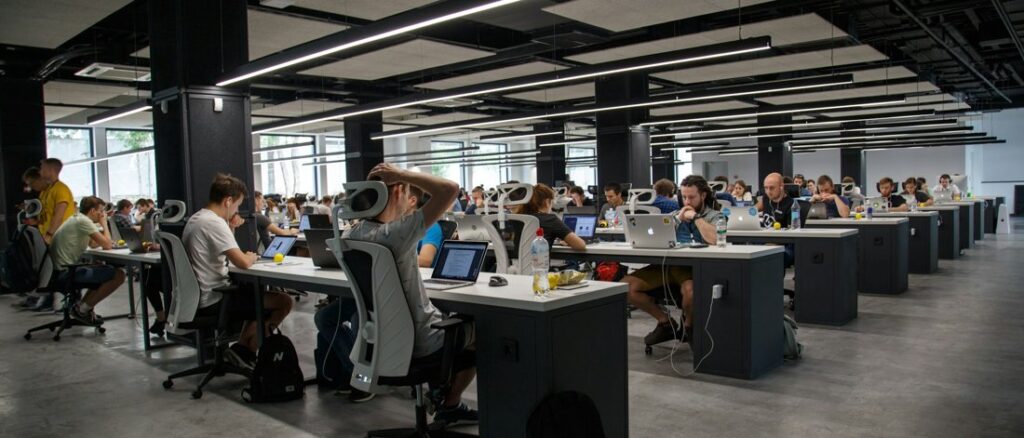
1. Scale Candidate Screening Without Scaling Recruiter Workload
One of the biggest advantages of AI interview software is its ability to increase interview capacity.
Candidates can complete interviews asynchronously, meaning recruiters don’t need to coordinate individual schedules for every first-round conversation.
This creates a more scalable process:
Application → AI Interview → Assessment → Recruiter Review → Human Interview → Hiring Decision
The AI handles the repetitive assessment layer while recruiters concentrate on reviewing stronger candidates.
For enterprises managing large recruitment campaigns, this can help reduce administrative workload and prevent screening from becoming the slowest stage of the hiring funnel.
2. Standardize Interviews Across Teams and Locations
Consistency becomes increasingly difficult as organizations grow.
Different recruiters may ask different questions. Hiring managers may interpret competencies differently. Candidates applying for the same role can end up being assessed using different criteria.
Structured AI interviews can help create greater consistency by applying standardized questions and evaluation criteria across candidates. Interviewer.AI, for example, positions structured interviewing around using the same questions, order, and evaluation criteria to support consistent comparison.
For global enterprises, this can be especially valuable.
A standardized interview framework can help teams maintain consistent assessment principles across departments, locations, and recruitment campaigns while still allowing organizations to customize assessments for specific roles.
3. Assess Skills Beyond the Resume
Resumes provide useful background information, but they do not always demonstrate whether a candidate can perform the job.
AI interviews give organizations another opportunity to evaluate job-relevant competencies.
For example, a customer support role might require:
- Communication
- Active listening
- Empathy
- Problem-solving
- Conflict resolution
A sales role might require:
- Communication
- Discovery skills
- Persuasion
- Objection handling
- Commercial awareness
The important consideration is that enterprises should define the competencies that matter before evaluating candidates.
AI should be used to assess relevant evidence—not simply generate a score without context.
4. Integrate AI Interviews Into the Existing Hiring Stack
Enterprise recruiting teams rarely operate from a single system.
An organization may use an ATS, HRIS, recruitment marketing platform, assessment tools, scheduling software, and internal reporting systems.
For that reason, integration should be a major consideration when selecting AI interview software.
A well-integrated platform can automatically trigger an interview when a candidate reaches a particular stage in the ATS and return interview results to the candidate record. Interviewer.AI currently supports integrations with a range of ATS platforms and provides API capabilities for custom connections.
This reduces manual data entry and allows recruiters to continue working within familiar systems.
For enterprise organizations, integration isn’t simply a convenience. It can determine whether an AI interview platform becomes part of the recruitment workflow or becomes another disconnected application recruiters have to manage.
5. Give Recruiters Actionable Interview Insights
Enterprise recruiting teams don’t need more data for the sake of having more data.
They need information that helps them make better decisions.
Useful AI interview software can provide structured insights such as:
- Interview summaries
- Transcripts
- Competency scores
- Detailed score breakdowns
- Candidate comparisons
- Hiring recommendations
- Interview trends
These insights can help recruiters quickly understand candidate responses without having to spend the same amount of time reviewing every interview manually.
However, transparency is essential.
Recruiters should be able to understand what the system is evaluating and review the underlying candidate evidence rather than treating AI-generated recommendations as unquestionable decisions.

6. Build Human Oversight Into the Process
Enterprise hiring decisions can have significant consequences for both candidates and organizations.
AI should therefore be part of a human-in-the-loop hiring model.
Recruiters should define evaluation criteria, monitor assessment quality, review candidate evidence, and retain responsibility for final hiring decisions.
This is particularly important when implementing AI across different roles and geographies.
Organizations should regularly review whether assessment criteria remain job-relevant and whether the system is producing useful and consistent results.
The goal is not to automate judgment. It is to automate repetitive work while giving recruiters better information for exercising judgment.
7. Support Enterprise Security and Compliance
Candidate interviews contain sensitive personal information, so security should be part of the buying process from the beginning.
Enterprise buyers should evaluate areas such as:
- Data protection
- Encryption
- Access controls
- Authentication
- Auditability
- Data retention
- Compliance documentation
- Data residency
- Administrative controls
Organizations operating across multiple countries should also consider regional privacy and employment requirements.
Enterprise AI interview platforms may provide additional security, compliance, audit, and data-residency controls beyond standard plans. For example, Interviewer.AI’s enterprise offering includes enterprise security, compliance and audit controls, as well as data residency flexibility.
Security requirements should be reviewed with the organization’s IT, legal, procurement, and data protection teams before deployment.
8. Measure the Business Impact
An enterprise AI interview implementation should be measured like any other technology investment.
Important metrics can include:
- Time spent on initial screening
- Interview completion rates
- Candidate progression rates
- Time-to-hire
- Recruiter productivity
- Interview-to-hire conversion
- Candidate drop-off
- Hiring manager satisfaction
- Quality of hire
- Cost per hire
The most important question is not simply how many interviews the AI platform conducted.
It’s whether the technology improves the overall hiring process.
For example, if recruiters can screen more candidates while spending less time on repetitive interviews, they may be able to focus more attention on qualified candidates and hiring-manager engagement.
How to Choose AI Interview Software for Enterprise Hiring
Before selecting a platform, enterprise hiring leaders should evaluate several areas.
Candidate experience
Complete the interview yourself. Is it intuitive, accessible, mobile-friendly, and easy to understand?
Assessment quality
Understand exactly what the AI evaluates and whether criteria can be customized for different roles.
Scalability
Determine whether the platform can support your candidate volume during both normal hiring and recruitment surges.
Integration
Check compatibility with your ATS and other systems. Ask whether native integrations, APIs, webhooks, or custom connectors are available.
Security
Review security documentation, access controls, compliance requirements, data retention, and residency options.
Analytics
Make sure recruiters and talent leaders can measure both operational efficiency and hiring outcomes.
Human oversight
Understand how recruiters can review candidate evidence and override or contextualize automated insights.
The Future of Enterprise Hiring Is Human + AI
AI interview software is not about replacing the recruiter.
It’s about changing where recruiters spend their time.
When AI handles repetitive first-round screening, recruiters can focus more heavily on candidate engagement, complex assessments, hiring-manager relationships, and final decision-making.
For enterprise organizations, the value becomes even greater because the technology can bring structure and scalability to hiring processes that span thousands of candidates and multiple teams.
The strongest enterprise hiring strategies will combine AI-powered efficiency with human judgment.
Organizations that approach AI interviews as part of a broader skills-based, structured, and data-informed recruitment strategy can build hiring processes that are faster to scale without losing the human expertise that good hiring decisions require.
The goal isn’t simply to interview more candidates.
It’s to identify the right candidates, more consistently, at enterprise scale.
Interviewer.AI is a purpose-built technology platform designed to help recruiters and HR teams identify and hire the right talent with greater confidence and efficiency. We also partner with universities to support admissions and coaching, enabling them to use technology to better assess potential, skills, and readiness. Our mission is to make hiring more equitable, explainable, and efficient by enabling teams to screen candidates early and shortlist those who best meet role-specific criteria.
Schedule a demo today to learn more about how AI interviews can help your hiring.

Gabrielle Martinsson is a Content Writer at Interviewer.AI. She’s a tech geek and loves optimizing business processes with the aid of tech tools. She also loves travelling and listening to music in her leisure.