High-volume staffing has always been a numbers game.
When an organization needs to hire dozens, hundreds, or even thousands of people, recruiting teams face a familiar challenge: how do you evaluate a large pool of candidates quickly without sacrificing quality or candidate experience?
Traditional hiring processes can struggle under this pressure. Recruiters may spend hours reviewing resumes, conducting repetitive screening calls, coordinating interviews, and comparing candidates across multiple stages. As application volumes increase, bottlenecks become harder to avoid.
For high-volume staffing teams, AI can help transform recruitment from a largely manual, sequential process into a more scalable and structured workflow. The advantage isn’t simply that AI can automate individual tasks. Its bigger potential lies in helping recruiting teams process more candidates, gather more structured information, and focus human attention where it matters most.
What Makes High-Volume Staffing Different?
High-volume recruitment has unique operational challenges.
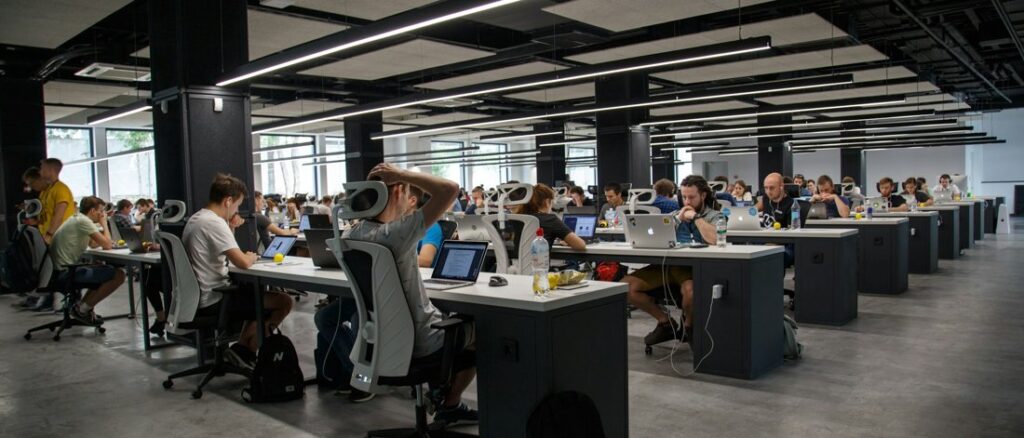
A recruiter hiring for a highly specialized role might only need to evaluate a few dozen candidates. A staffing agency, BPO, retail organization, logistics company, healthcare provider, or large enterprise may need to process hundreds or thousands of applicants for similar positions.
The challenge isn’t necessarily finding candidates.
It is evaluating them efficiently.
Recruiters need to answer questions such as:
- Does the candidate meet the basic requirements?
- Do they have the relevant skills?
- Can they communicate effectively?
- Are they suitable for the role?
- Which candidates should move forward?
- How can candidates be evaluated consistently?
- How can the recruiting team keep up with demand?
This is where AI can have a meaningful impact.
AI Can Automate the First Layer of Screening
Resume screening is often one of the first bottlenecks in high-volume recruitment.
Recruiters may need to review hundreds of resumes to identify candidates who meet the basic requirements for a position.
AI can help analyze resumes against predefined job requirements and surface relevant information more efficiently.
Instead of manually searching through every resume, recruiters can receive structured insights that help them identify candidates who warrant further consideration.
This doesn’t mean the AI needs to make the final hiring decision.
Instead, it can reduce the amount of repetitive reading and comparison required before a recruiter gets involved.
That distinction is important.
The goal is not to remove humans from recruitment. It is to make human time more valuable.
Assess More Candidates Without Scheduling More Calls
The next bottleneck is often the initial interview.
Traditional screening calls require coordination between recruiters and candidates. When hundreds of candidates are involved, scheduling alone can consume significant time.
AI-powered interviews introduce an asynchronous option.
Candidates can complete a one-way video interview at a convenient time, while recruiters can review the resulting responses later.
This can dramatically change the operational model.
Instead of:
Recruiter availability → Candidate availability → Scheduled call → Interview → Notes → Next candidate
the workflow can become:
Candidate invited → Candidate completes interview → AI structures insights → Recruiter reviews results
For high-volume hiring, that shift can reduce scheduling friction and allow the recruiting team to process candidates more efficiently.
Dynamic AI Interviews Add Another Layer
Not every candidate needs exactly the same interview experience.
This is where dynamic AI interviews can provide another advantage.
Rather than simply presenting every candidate with the same fixed list of questions, a dynamic interview can adapt questions based on the candidate’s previous responses and the requirements of the role.
For example, a candidate’s response to a situational question might lead to a relevant follow-up question.
This creates a more interactive assessment while maintaining the scalability of an AI-powered process.
For recruiters, the benefit is the ability to gather richer information without requiring a recruiter to conduct every initial interview personally.
Consistency Becomes Easier to Achieve
High-volume hiring creates another challenge: consistency.
When multiple recruiters are screening hundreds of candidates, differences in interviewing style, questioning, note-taking, and evaluation can make comparisons difficult.
A structured AI workflow can standardize parts of the process.
Candidates can be assessed against the same role requirements, competency areas, and interview framework.
This creates a more consistent dataset for recruiters and hiring managers to review.
Consistency doesn’t automatically guarantee fairness, however. Organizations should regularly review their evaluation criteria, interview questions, and outcomes to ensure the process is appropriate for the role and complies with applicable employment requirements.
AI Can Connect the Entire Hiring Workflow
The biggest opportunity may come from connecting multiple stages rather than automating one task.
Imagine a high-volume hiring workflow that looks like this:
Job Description → Resume Screening → Skills Assessment → AI Interview → Shortlist → Human Interview
Traditionally, these stages may be managed through separate systems.
AI can help connect the information across the funnel.
The requirements in a job description can inform screening criteria. Screening results can help determine who progresses to an assessment. Assessment results can inform the interview. Interview insights can then be presented alongside resume and assessment information.
This creates a more connected candidate profile.
Recruiters don’t have to start from scratch at every stage.

Recruiters Can Focus on Exceptions and High-Value Decisions
One of the most powerful concepts in AI-assisted recruitment is exception-based work.
Instead of requiring recruiters to manually process every candidate in exactly the same way, AI can handle the predictable, repetitive parts of the workflow and bring human attention to cases that require interpretation.
A recruiter can spend less time asking:
“Which candidates meet the basic criteria?”
and more time asking:
“Which of these candidates deserves a deeper conversation?”
That is a significant shift in how recruiting time is allocated.
For staffing organizations, where recruiter productivity directly affects the ability to fill roles at scale, this can be particularly valuable.
Candidate Experience Matters at Scale
High-volume staffing is not only about recruiter efficiency.
Candidates also experience the consequences of a slow or fragmented hiring process.
Long delays, repeated questions, complicated scheduling, and unclear next steps can create friction.
AI can help organizations provide a more responsive experience.
Candidates can receive automated invitations, complete assessments or interviews asynchronously, and progress through defined stages without waiting for a recruiter to manually coordinate every step.
At the same time, organizations should be careful not to turn automation into impersonality.
Clear communication, transparency, accessibility, and opportunities for appropriate human interaction remain important.
AI Doesn’t Replace the Recruiter
One of the biggest misconceptions about AI in staffing is that its purpose is to replace recruiters.
For most organizations, the more practical opportunity is different.
AI can take on repetitive information processing, while recruiters focus on relationship building, candidate conversations, hiring manager collaboration, and final evaluation.
This creates a complementary model:
AI provides scale.
Recruiters provide judgment.
That combination can be particularly powerful when application volumes are high.
Measuring the AI Advantage
Organizations considering AI for high-volume staffing should look beyond the number of automated tasks.
Useful measures can include:
- Time spent screening candidates
- Time from application to shortlist
- Interview scheduling effort
- Candidate completion rates
- Recruiter workload
- Time-to-hire
- Candidate experience
- Quality and consistency of evaluation
- Hiring manager satisfaction
The objective should be to determine whether AI is improving the overall workflow, not simply whether individual features are being used.
The Future of High-Volume Staffing
High-volume staffing will always require speed.
But speed alone isn’t enough.
Organizations need to process candidates efficiently while maintaining structured evaluation, candidate engagement, and appropriate human oversight.
AI provides an opportunity to rethink how that balance is achieved.
Instead of adding more recruiters every time candidate volume increases, organizations can build workflows that allow technology to handle more of the repetitive workload while recruiters focus on the decisions and interactions that require human judgment.
The future of high-volume staffing isn’t about choosing between people and AI.
It’s about designing a workflow where both do what they are best equipped to do.
AI can help staffing teams move from manually processing every candidate to intelligently managing the entire candidate funnel — creating the potential to hire at scale without allowing scale itself to become the bottleneck.
Interviewer.AI is a purpose-built technology platform designed to help recruiters and HR teams identify and hire the right talent with greater confidence and efficiency. We also partner with universities to support admissions and coaching, enabling them to use technology to better assess potential, skills, and readiness. Our mission is to make hiring more equitable, explainable, and efficient by enabling teams to screen candidates early and shortlist those who best meet role-specific criteria.
Schedule a demo today to learn more about how AI interviews can help your hiring.

Gabrielle Martinsson is a Content Writer at Interviewer.AI. She’s a tech geek and loves optimizing business processes with the aid of tech tools. She also loves travelling and listening to music in her leisure.