
Explainable AI

Interviewer.AI - What’s the technology behind it?

Our Explainable
AI Approach

At Interviewer.AI, we build Explainable AI[1] to help teams identify desirable talents in their talent acquisition processes. Having an Explainable AI framework allows us to provide insights on the key performance factors of candidates and minimize the risk of prejudice judgements that may arise from black-box AI approaches.
interviewer

Features of
Interviewer.AI

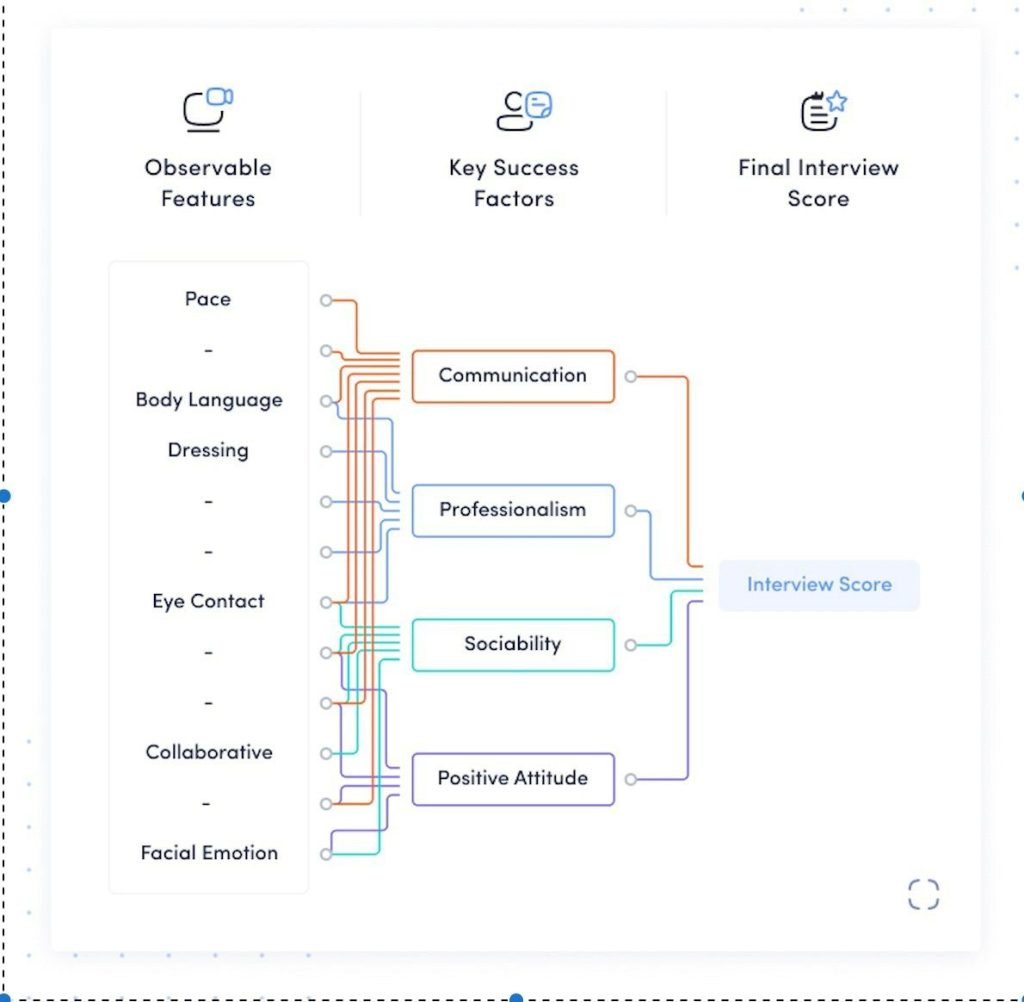
Our Explainable Al assesses interview candidates’ soft skills through evaluation of key success factors identified by I/O psychology heuristics and industry knowledge
From asynchronous video interview data provided by candidates. visual, audio and textual information can be extracted for computer vision. natural language processing. and audio analysis tasks for our Al to perform.
These observable pieces of information are evaluated by our Narrow Als (41 that were built to specifically measure these observable features of a candidate such as eye-contact. emotional state, energy level. etc.
These observable features are then provided as data points to evaluate the candidates’ key success factors through a combination of I/O psychology heuristics and machine learning to arrive at the final interview score of the candidate.
ai recruiting

AI Recruiting

Using AI to assess talent better for your business.

Assessment icon

Assessment

Our Al models are trained to be blind towards age. genders. ethnicity for a fair and objective assessment approach.

Fare decision icon

Fair decision

Our model training datasets are global and purposefully curated to avoid any undesirable historical biases in hiring, we ensure that there are fair representation of age-groups, genders, and ethnicity for each label in our supervised training datasets.

Values icon

Values

When augmented with traditional talent acquisition human resource processes, our explainable Al brings the value of objectiveness, scalability and explainability to the professional human teams to boost the effectiveness and efficiency of the department.


Addressing Common
Concerns Regarding our AI

References

  1. Gunning, D., Stefik, M., Choi, J., Miller, T., Stumpf, S., & Yang, G. Z. (2019). XAI—Explainable artificial intelligence. Science Robotics4(37).
  2. Robles, M. M. (2012). Executive perceptions of the top 10 soft skills needed in today’s workplace. Business communication quarterly75(4), 453-465. 
  3. Kačamakovic, M. K., & Lokaj, A. S. (2021). Requirements of Organization for Soft Skills as an Influencing Factor of Their Success. Academic Journal of Interdisciplinary Studies10(1), 295-295.
  4. Dickson, B. (2017, May 12). What is Narrow, General and Super Artificial Intelligence. TechTalks. https://bdtechtalks.com/2017/05/12/what-is-narrow-general-and-super-artificial-intelligence/.
  5. Correll, S. J., & Benard, S. (2006). Gender and racial bias in hiring. Memorandum report for University of Pennsylvania.
  6. Petersen, T., & Togstad, T. (2006). Getting the offer: Sex discrimination in hiring. Research in Social Stratification and Mobility24(3), 239-257..
  7. Wilson, M., Parker, P., & Kan, J. (2007). Age biases in employment: Impact of talent shortages and age on hiring. University of Auckland Business Review9(1). Dickson, B. (2017, May 12).
Scroll to Top

Request a Demo

Get in touch with us and we will provide a solution that meets your exact requirements

hiring